The Sunday Night Text
Every Sunday night, around nine, I used to send the same kind of message.
Something like: Tuesday is picture day, the 8yo needs the green shirt (not the blue one, the green one, it’s clean and on the shelf), the 5yo has swim so pack the backpack with the goggles and the snack, I have a dentist thing at 2 so can you get school pickup, and the thing on Thursday got moved to Wednesday.
My husband would read it, thumbs-up the message, and then on Wednesday ask me what time the thing was.
Not because he didn’t care. Not because he wasn’t paying attention. Because the message had lived for fifteen seconds in his phone and then gotten buried under work emails, and the only person still carrying all of those details at the start of the week was me.
If you have ever sent a version of that message, you already know what this piece is about. You are the household’s secretary. And the job is making you tired.
What the Mental Load Conversation Gets Right
The last few years have been good for naming things. “Mental load.” “Invisible labor.” “The default parent.” A Reddit mom I saw recently called it “running a tiny business that nobody else knows about,” and honestly that is the most accurate phrase I have read.
The naming matters. For a long time the tiredness didn’t have language, and without language it was impossible to explain to a partner why you were cross at 9pm when dinner was fine and the kids were in bed. The language gave us a handle.
But naming a problem and fixing it are different things. Every article I’ve read about the mental load stops at the same place: notice the labor. Share the load. Have the conversation. And then you do have the conversation, and your partner agrees, and for about ten days things feel a little better, and then you are back to sending the Sunday night text because nobody else is tracking that Tuesday is picture day.
This isn’t a partner failing, mostly. It’s a structural failing. The mental load conversation tells you to share the work. The work is almost impossible to share the way it currently exists.
You Can’t Share What Nobody Else Sees
I wish someone had told me this five years earlier.
Invisible labor is called invisible for a reason. It lives inside one person’s head. The list of what the family needs this week, who has which appointment, what is running low in the pantry, which child is at which friend’s house today. None of that is written down anywhere the whole household can see. It is a working memory that one parent maintains and updates continuously.
You can’t split that.
You can split a list, if there is a list. You can split a calendar, if there is a calendar everyone reads. But you can’t ask someone else to help you carry a thing that exists only as a feeling in your own chest of “oh wait, Tuesday.” The work of being the list is the job that’s exhausting, and it doesn’t get lighter just because someone else has agreed to help when asked.
The fix starts earlier than most articles say it does. Before you can share the load, you have to externalize it. You have to put it somewhere the rest of the family can see without you narrating it.
The Tablet on the Wall Is the Family Secretary
This is where I stopped being the secretary.
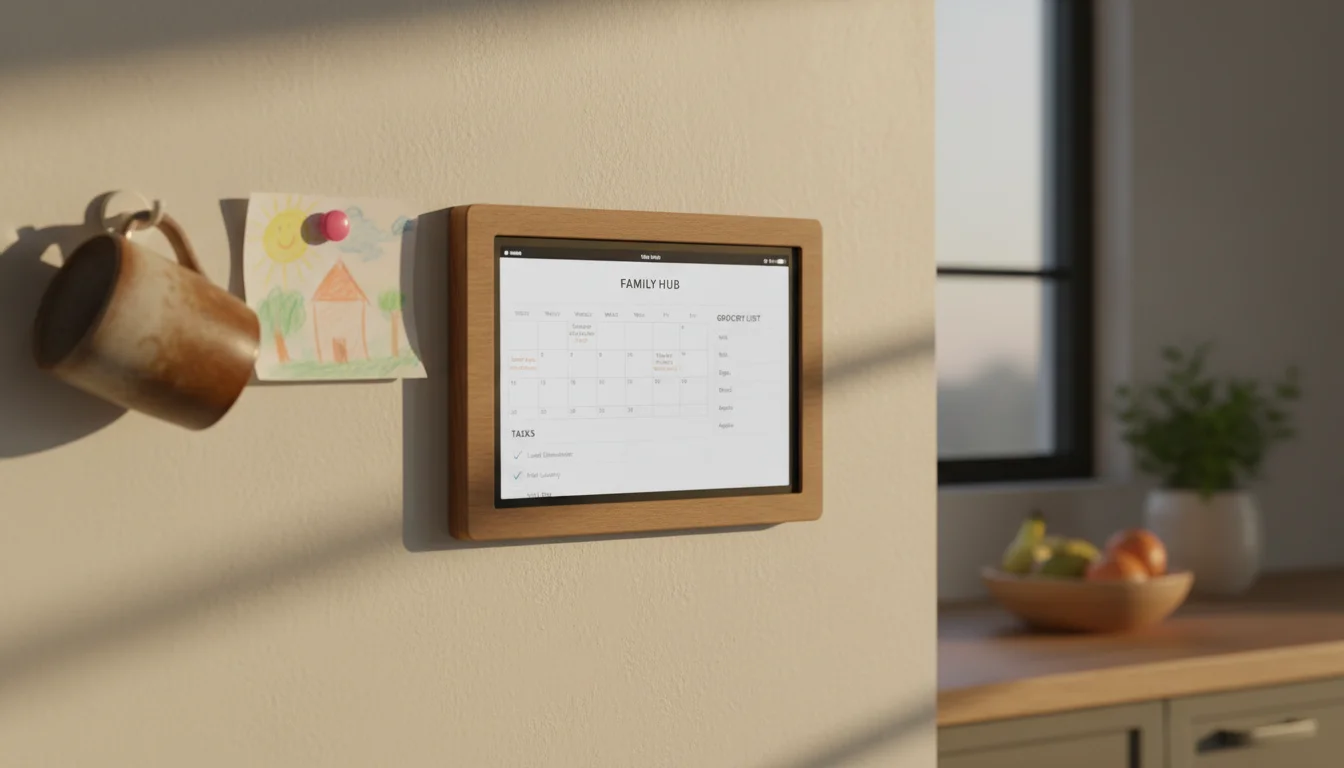
We have an old iPad. It is a 2018 model, the one with the cracked corner that I was never going to use for anything else. It lives on a ledge in our kitchen, plugged in, screen on, showing this week’s calendar and today’s list. The kids walk past it on the way to breakfast. My husband sees it when he makes coffee. It is eye level. It is always on. It is not hidden inside an app on my phone, where only I can see it.
The old tablet is now the secretary. It carries the week. It tells the family what is happening today and tomorrow and Thursday. It holds the grocery list in a way that anyone can add to. It shows the kid who has swim that the goggles need to be in the bag, because the calendar entry says “swim – pack goggles” and he can read at age eight.
I still maintain it. Someone has to curate the display. But the work of curating a visible system is a small fraction of the work of being the living repository, and that’s the whole shift.
I am not selling a dedicated smart display here. I used to cost-compare those against what we already had in the drawer and if you want that analysis, the tablet versus digital calendar display piece breaks it down. This isn’t about what hardware you buy. It’s about whether there is a shared artifact at all. One tablet can carry a surprising amount at once, which is the broader argument of the ways an old tablet works for the whole family piece.
What It Actually Carries
People ask me what goes on the display. The specific answer is less interesting than the principle, which is: anything that lives only in your head.
In our house that is:
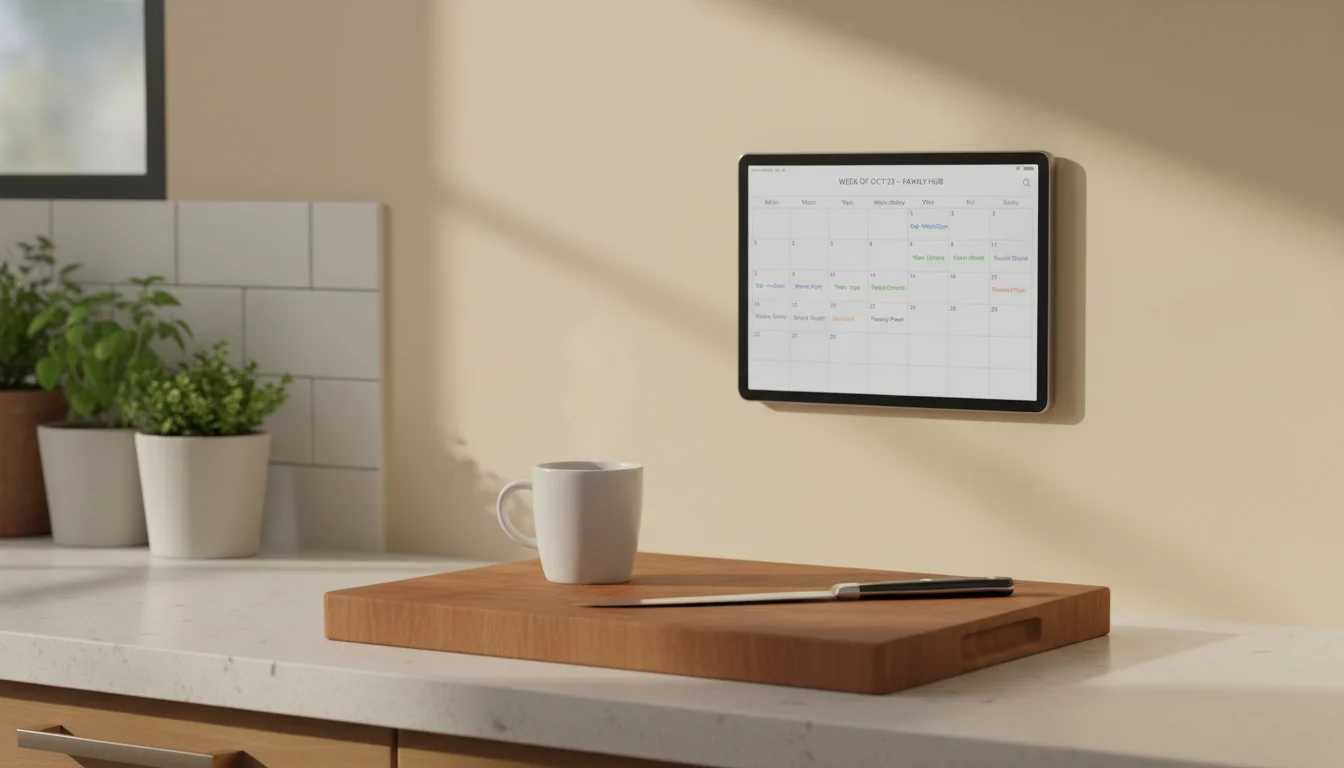
The week’s calendar. School stuff, doctor stuff, my husband’s travel, the kids’ activities, the dinner that my parents are coming over for. We use  Google Calendar because it syncs to everyone’s phone, and the tablet just displays it. If you want the mechanics of actually getting it set up, that’s in the shared family calendar guide.
Today’s routines. The morning run of “eat, teeth, shoes, bag, out the door” and the evening run of “baths, pajamas, books, lights out.” When the 5-year-old knows what comes next without asking me, that is six questions I am not answering before 8am. The morning routine board and the after-school board are the versions we built.
The running grocery list. This is the one I underestimated. Anyone adds to the list from their phone. It shows on the tablet. When my husband uses the last of the yogurt, he adds yogurt. When I notice we are low on the specific pasta the 3-year-old will eat, I add it. No group text. No sticky note. No “did you add that.” A shared list on a screen we all pass.
The not-to-forget shelf. This is the one that removed the most weight. A short pinned note on the display for the things that won’t happen at a predictable time but need to happen this week. Library books back by Friday. Permission slip in the green folder. Someone needs to call the HVAC guy. Things that would otherwise live in the back of my mind as a low-grade hum.
That’s it. Four categories. It is not a dashboard of dashboards. It is the stuff the family needs to know this week, in one place, that isn’t just my brain.
What Changes When It’s Not Just in Your Head
The changes were smaller than I expected and then, in aggregate, much bigger.
My husband started answering his own questions. “What time is soccer?” stopped being a question to me. He would glance at the display and answer it. The first few times I noticed this I almost cried, which is embarrassing to type but true.
The kids started asking the tablet instead of me. The 8-year-old reads. The 5-year-old recognizes her name next to an activity and knows to get her bag. That meant fewer “mom, what’s happening today” loops at the start of the day.
My husband started adding things. When the doctor’s office called him to confirm an appointment, he put it on the calendar. When he committed us to something socially, he put it on the calendar. The display was the cue. Before the display, he would mention it to me and the mention would become my job.
The Sunday night text shrunk. Not gone. Shrunk. There are still genuine logistics I flag because he’s been in flight mode on Tuesdays, but the baseline week has migrated off my head and onto a shared surface. My brain at 9pm is quieter now, and that’s not nothing.
I will be honest that none of this changed my husband into a different person. He is the same lovely, slightly absent-minded man I married. The display did not reform him. It just gave him a thing to look at that is not my face, which turned out to be the piece that was missing.
What It Doesn’t Fix
I have to say this clearly because otherwise I am just another blog post promising that one small change will fix your marriage, and that is not a promise I can make.
A wall display does not fix an uneven partnership. If your partner isn’t looking at it, or looks at it and still expects you to tell them what it says, you have a different conversation to have, and that conversation is not going to be replaced by a tablet on a shelf.
A wall display does not eliminate the work. Someone still has to put things on the calendar. Someone still has to curate what’s pinned and what isn’t. That someone is probably still mostly you, at least at first. The work is lower volume than being the living repository, but it is not zero.
A wall display does not work if nobody sees it. Which is obvious and which is also why the placement matters. It has to be somewhere the whole family walks past daily, at eye level, always on. In our house that’s the kitchen. In yours it might be the hallway or the mudroom. It should not be in your office.
A wall display does not fix the kids being kids. The 5-year-old still forgets her swim goggles. The 8-year-old still claims he didn’t know about the field trip. Children will be children. But the display means that when they claim they didn’t know, you can point, and that is a different kind of conversation than “but I told you.”
How to Start Smaller Than You Think
You don’t need to buy a tablet. You don’t need to set up mounts and find apps and configure anything. The whole point of this piece is that the artifact matters more than the hardware.
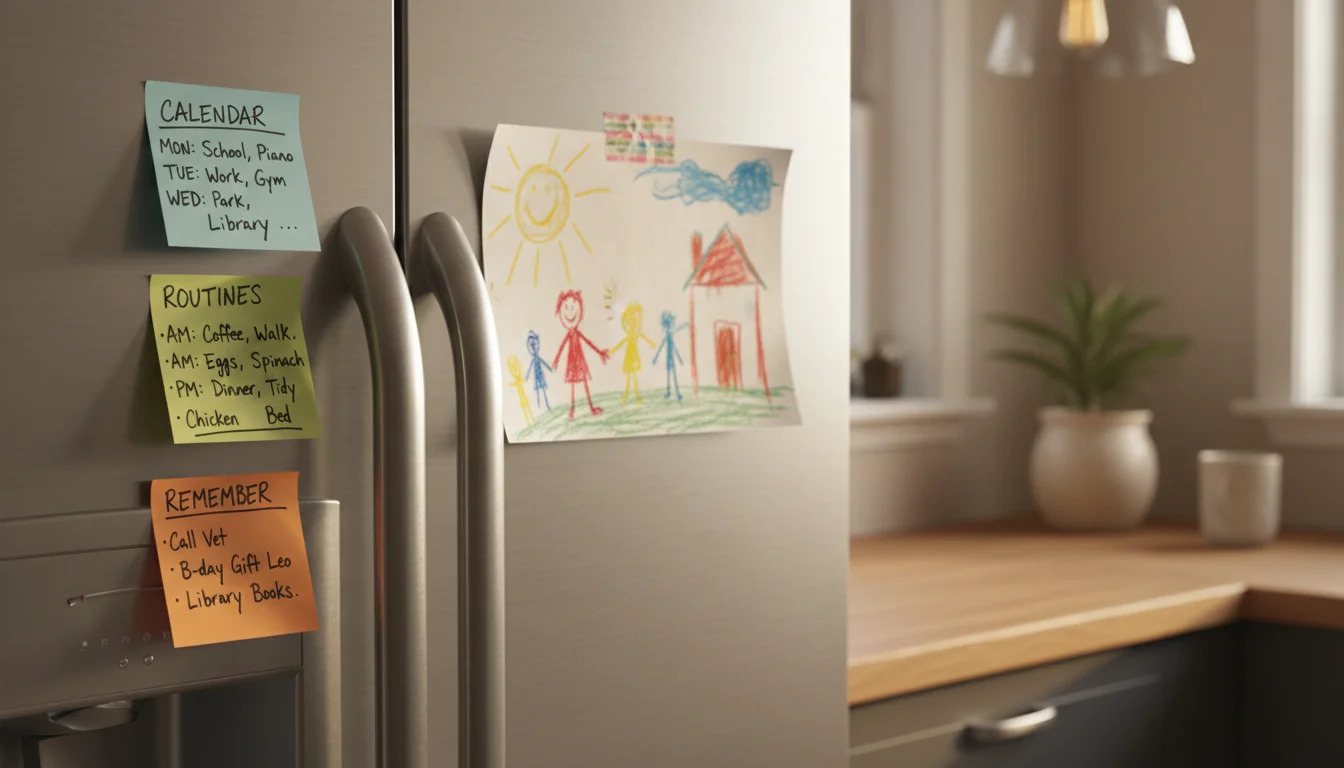
Tonight, do this: write this week’s calendar on a sheet of printer paper and tape it to the fridge. Week dates across the top, each day a column. Appointments under the day. Today’s routines scribbled at the bottom. The grocery list on the side.
That is the minimum viable family secretary. It is ugly. It works. Live with it for a week and see what happens.
If your partner starts answering their own “what time is soccer” questions, you’ve just proved the principle. The problem was never that they didn’t care. It was that there was nowhere else for the information to live except in your head.
Once you’ve proved it, the tablet on the wall is the permanent version. It doesn’t go away when the paper gets damp. It updates automatically when someone adds to the shared calendar. It shows today, not the whole week at a glance, which is actually easier to parse at 7am. If you want the actual setup (apps, mount, charging cable, the specific things I did), the shared family calendar guide walks through it, and the old tablet message board guide covers the list and note side. For a heavier weekly rhythm, we also started a 15-minute Sunday check-in that keeps the display honest – without the check-in, the calendar slowly drifts from reality and you are back to carrying it in your head.
The hardware is not the hard part. The question is whether you are willing to stop being the place where all of this information lives.
Sunday Night, Rewritten
Last Sunday I made the coffee the way I do. The kids were in bed, the house was quiet, my husband was doing something on his laptop. I didn’t send a text.
I walked past the tablet. Tuesday, picture day, green shirt. Thursday, my thing at 2. His pickup day. The grocery list showed we needed butter. I thought, huh, I’d forgotten about the butter.
And then I did the thing I couldn’t do a year ago, which was nothing. I didn’t send a reminder. I didn’t run a mental audit of who needed to know what. I didn’t lie in bed at eleven cycling through Wednesday.
The display had it. The family had it. I didn’t need to.
That is the whole point.